




 Share this article
Avto Meskhi’s biography once again proves the familiar truth that "non-mainstream" artists often become subjects of serious scholarly attention only after their death. The complete lack of creative and professional recognition that Avto Meskhi experienced during his lifetime cannot be logically explained. His biography goes beyond both tragedy and comedy, being more reminiscent of the theater of the absurd, or perhaps tragifarce.
Avto Meskhi seemed to exist in a world of his own, like an “Angel of Base,” or a duende wandering among the ruins of avant-garde art. It is difficult to classify him within any specific style, or to assign him a fixed place in Georgian fine art. The clichés of “unofficial” or “nonconformist” art feel too inadequate—too superficial to capture the depth of his practice. His artistic matrix transcends both stylistic boundaries and established artistic processes: he seemed to exist in a state of constant existential suspension.
The artist was at odds with life, with canon, and even with the "iconography" of geometric abstraction. His mode of expression simply did not align with the Soviet artistic paradigm; his serial abstract works speak obliquely of the tangible, material, and tactile world. Meskhi did not depict what is seen or documented, but what is forgotten, longed for, or banished from memory. Only through this approach could he craft a visual narrative that, for him, resonated as truthful—deeply personal, and emotionally convincing.
Avto Meskhi. Woman in the Mirror. Mixed media, paper. 40x29cm. 2008. ATINATI Private Collection
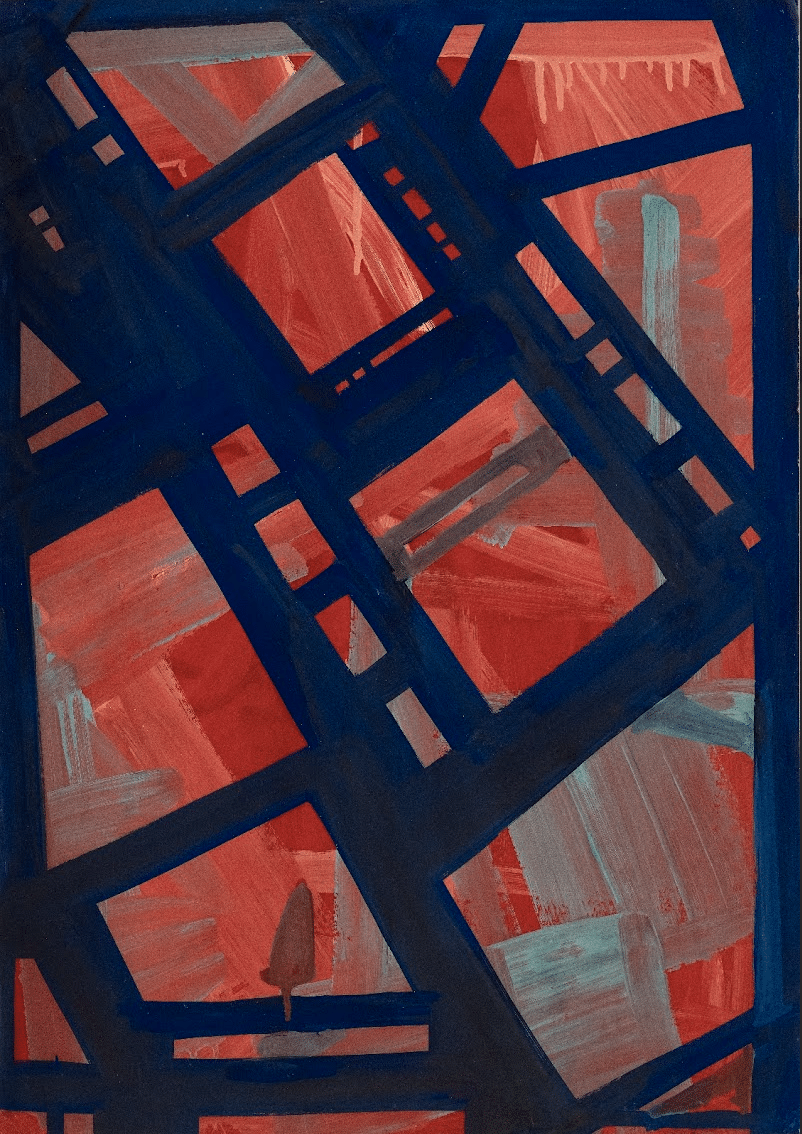
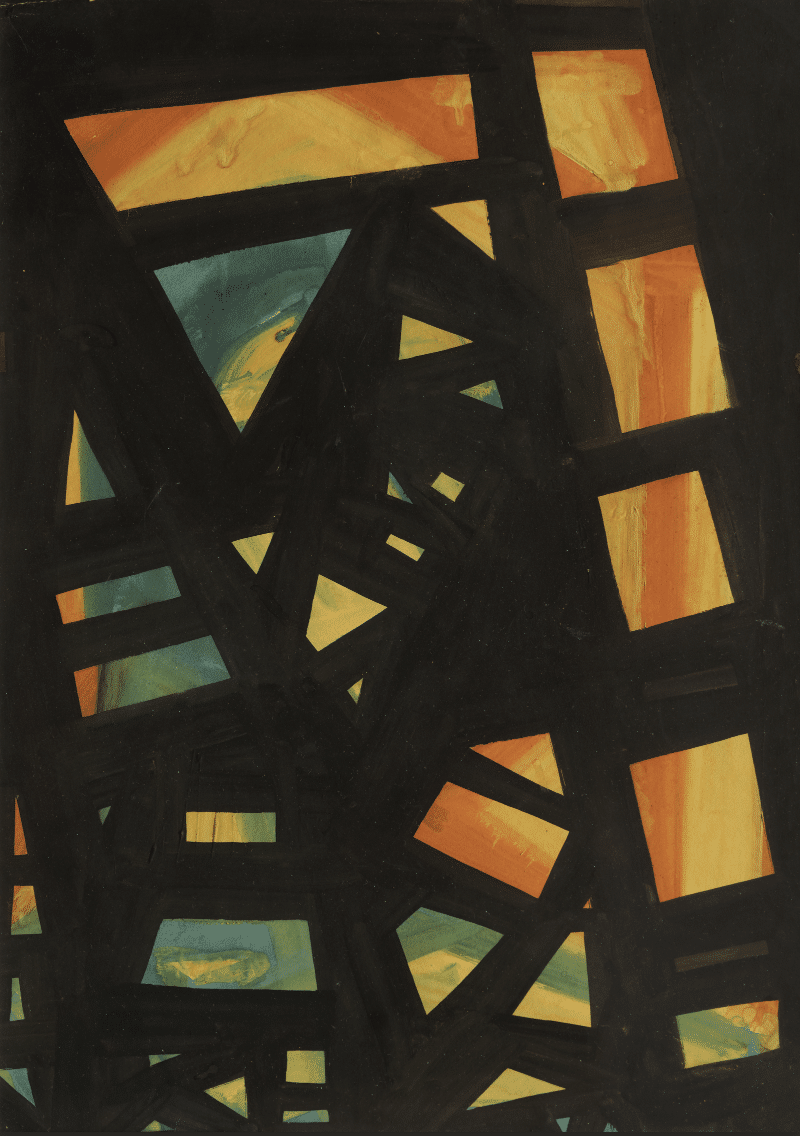
Avto Meskhi. Abstraction. Gouache on paper. 59x42cm. 1985. ATINATI Private Collection
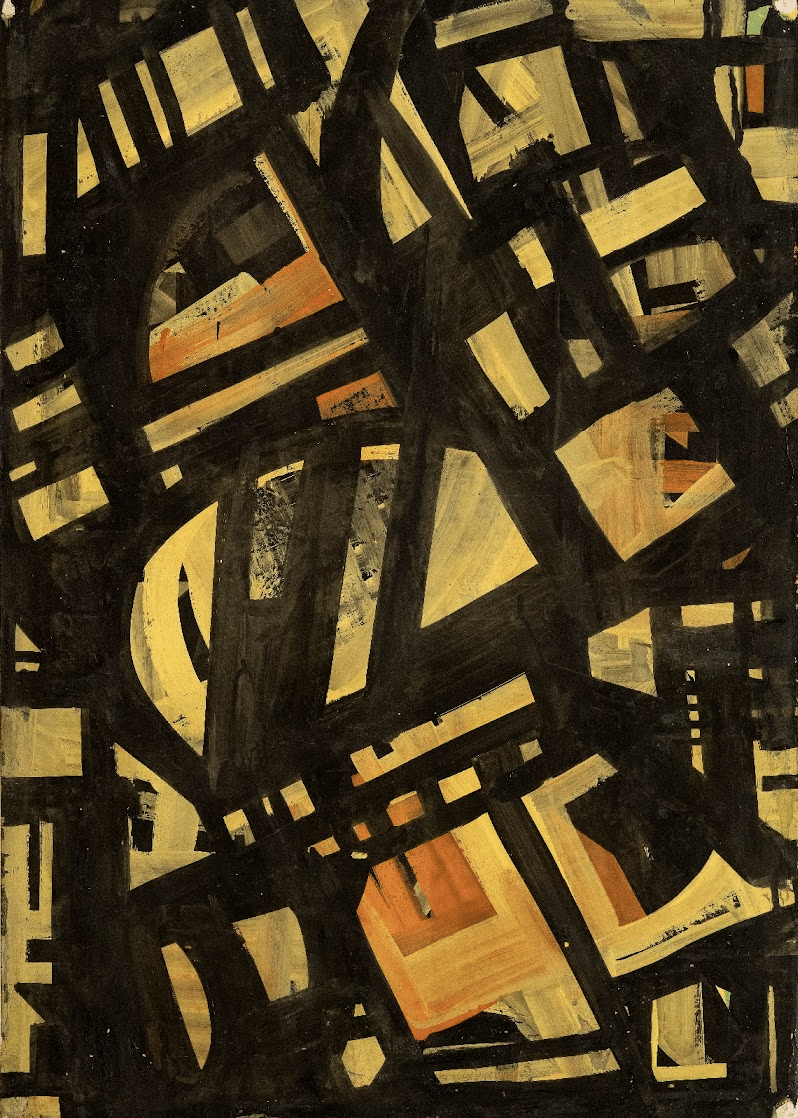
Avto Meskhi. Abstraction. Gouache on paper. 59x42cm. 1985. ATINATI Private Collection
In Avto Meskhi’s work, the union of title and image is irrevocable. Each piece bears a specific, poetic, and emotionally charged title. Yet the image does not illustrate the title; instead, it unsettles it, creating a space of playful ambiguity. Within Meskhi’s deeply subjective micromodel, we are struck by the dynamic interplay of color, form, and compositional stability. And still, these visual strategies never align directly with the meaning of the title. The expressive force of his blot-like and geometric abstractions is guided primarily by the title and, together, the two elements transform into something richer: connotation, metaphysics, syntagm, a semiotic unit. In Meskhi’s abstract world, we are frequently displaced from this zone of comfort.
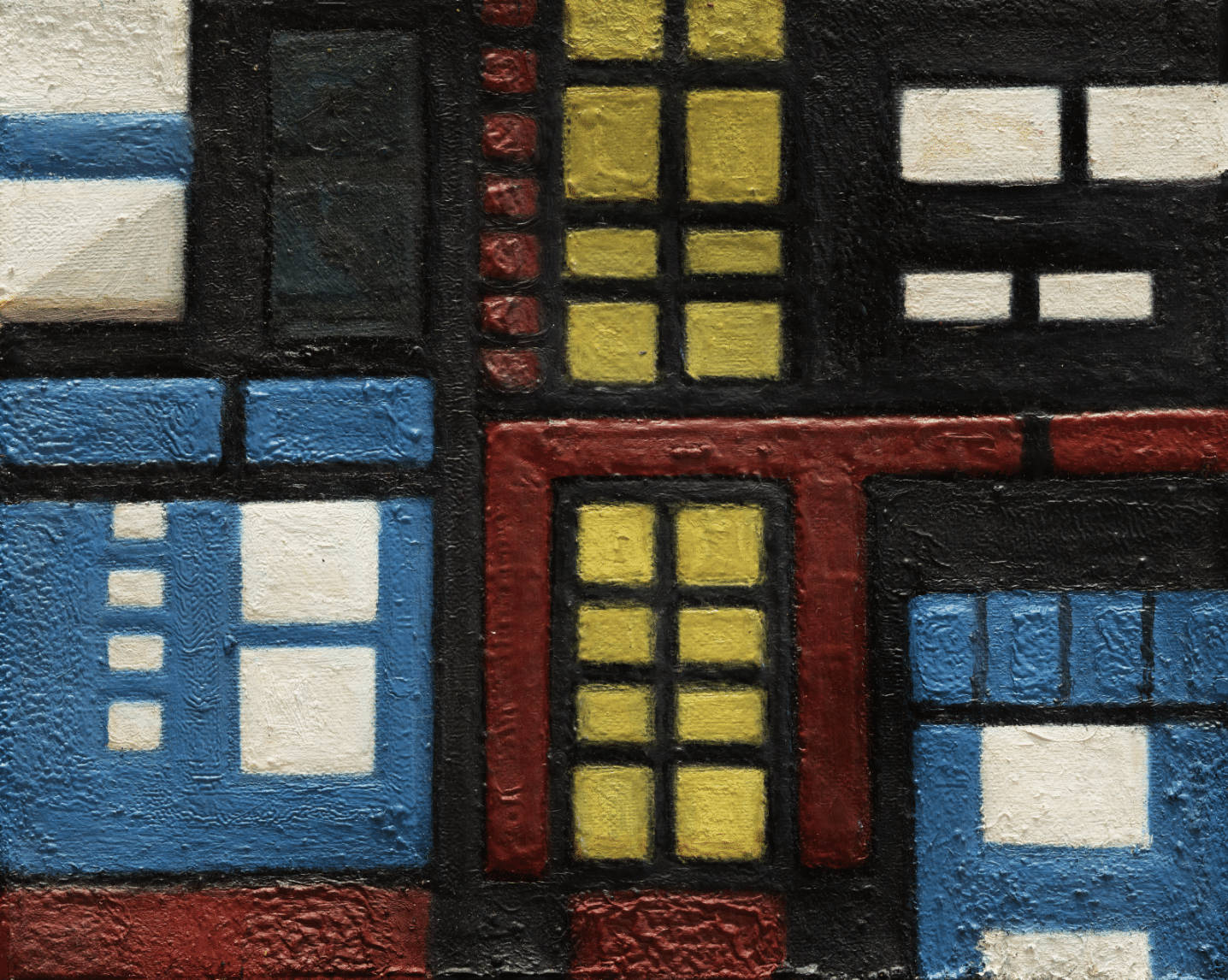
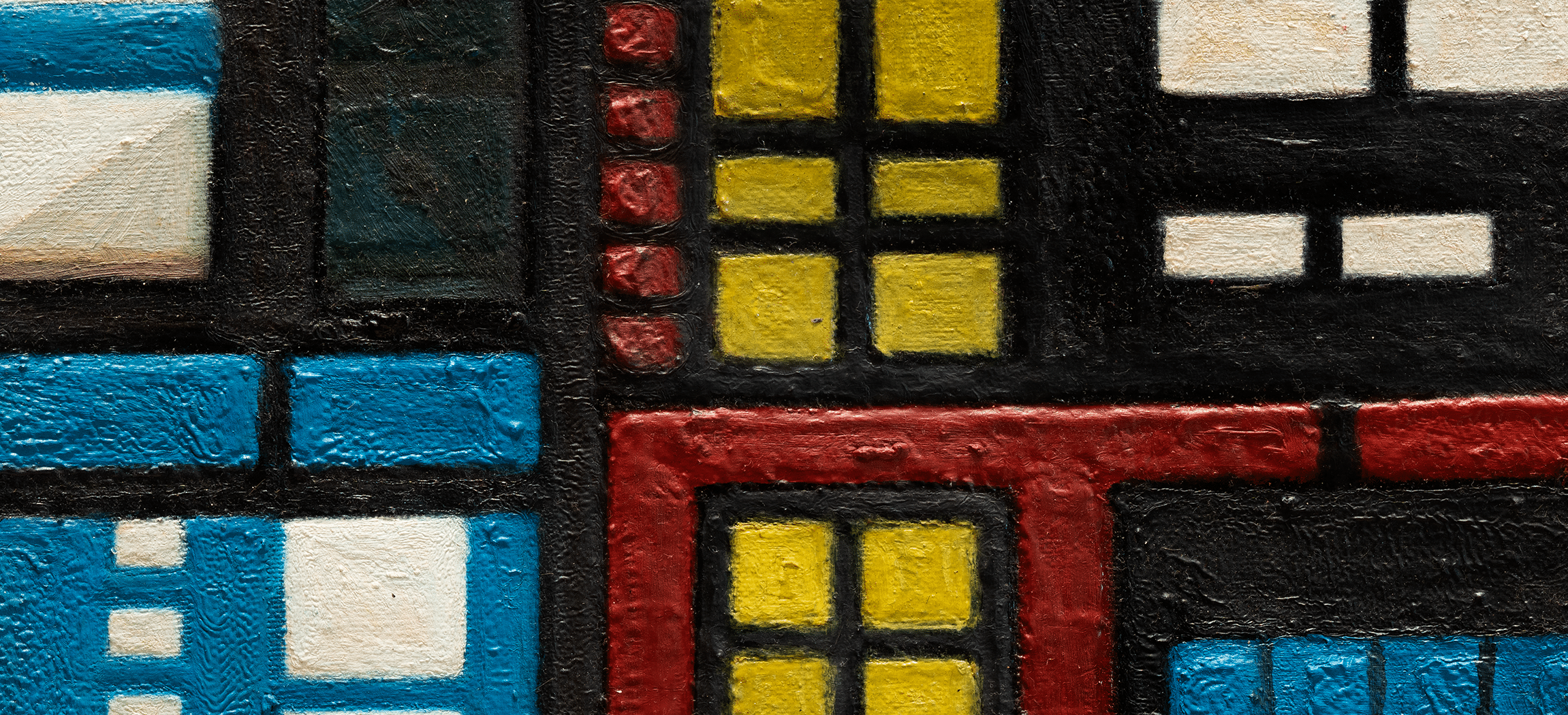
Avto Meskhi. Ice Cream Box. Oil, canvas. 24x30cm. 2008. ATINATI Private Collection
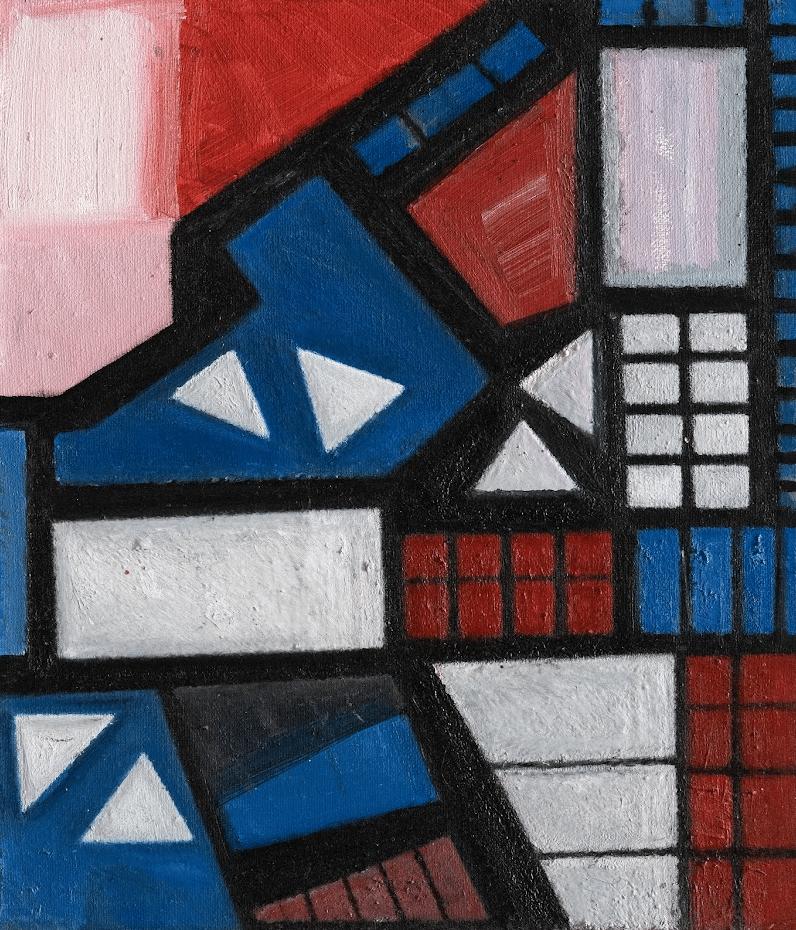
Avto Meskhi. Open Door. Oil, canvas. 35x30cm. 2014. ATINATI Private Collection
Avto Meskhi was born in Tbilisi in 1946. His mother was a Menshevik and was exiled, which led to his opposition to the Soviet regime from an early age. He developed a passion for painting in childhood, and later studied at the Iakob Nikoladze Art School under Ketevan Magalashvili. Meskhi attempted to enroll in the Academy of Arts twice, but was rejected both times. His painting style, which leaned toward abstraction, was not well accepted by the academic establishment. Introvert by nature, he remained somewhat distant from the mainstream art scene in Tbilisi. Around the age of 13 or 14, he made friends with Avto Varazi, who greatly influenced his artistic development. Their relationship went beyond friendship; they regularly engaged in deep conversations about contemporary art and Western painting, and Meskhi was first introduced to European avant-garde artists through the colorful art albums Varazi kept at home. He was especially captivated by the works of Picasso, Mondrian, and Malevich. Varazi often compared Meskhi to Pirosmani—not only in appearance and lifestyle, but perhaps in artistic destiny as well.
From 1968 onwards, Meskhi participated in several group exhibitions, including shows in Moscow (1974), St. Petersburg (1982), Bonn (1990), the Old Gallery, the House of Artists, and the National Gallery (as part of the group exhibition Reframing the 80s). Due to financial hardship, he lost his apartment in Tbilisi and spent his final years in a nursing home in Rustavi. He died in a car accident in 2016.
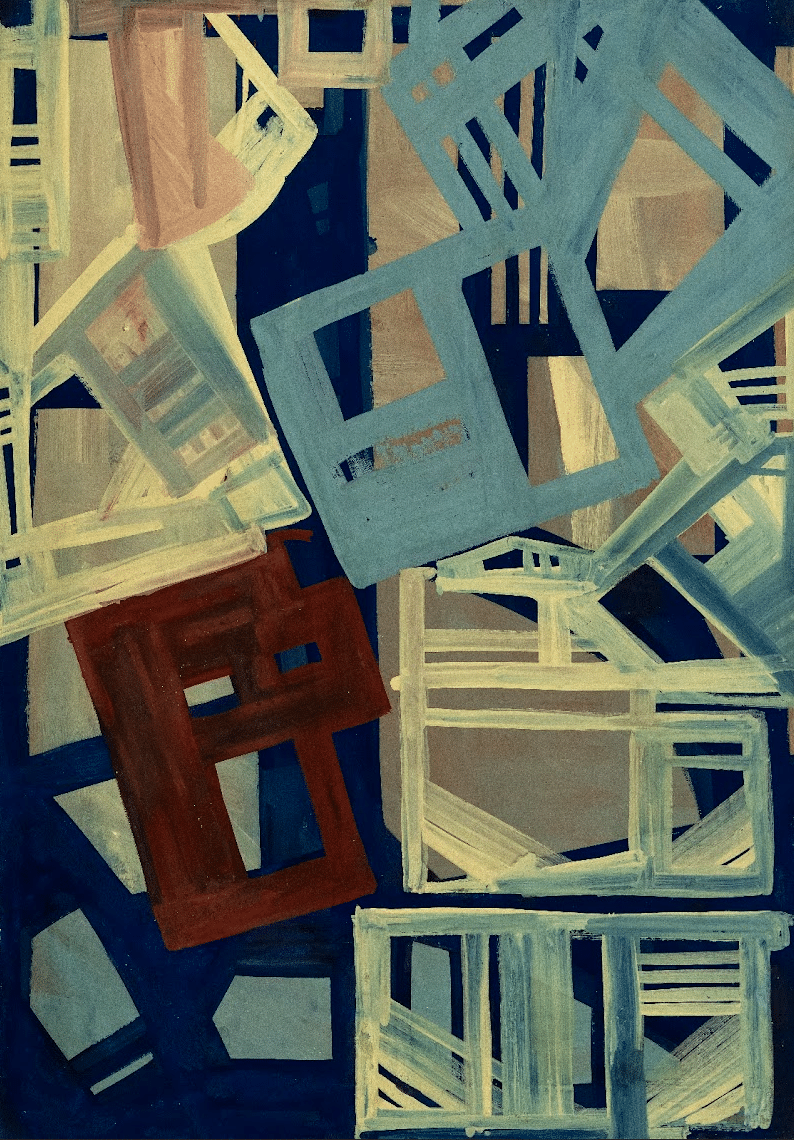
Avto Meskhi. Abstraction. Gouache on paper. 59x42cm. 1985. ATINATI Private Collection
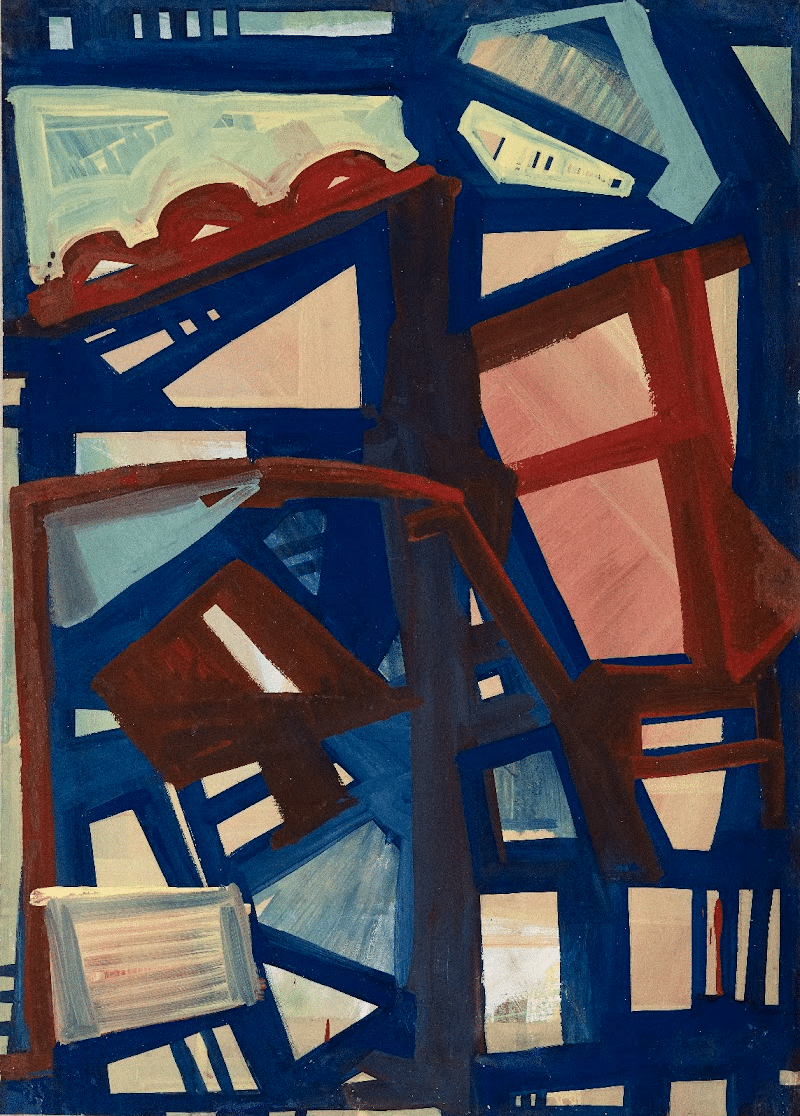
Avto Meskhi. Abstraction. Gouache on paper. 59x42cm. 1985. ATINATI Private Collection
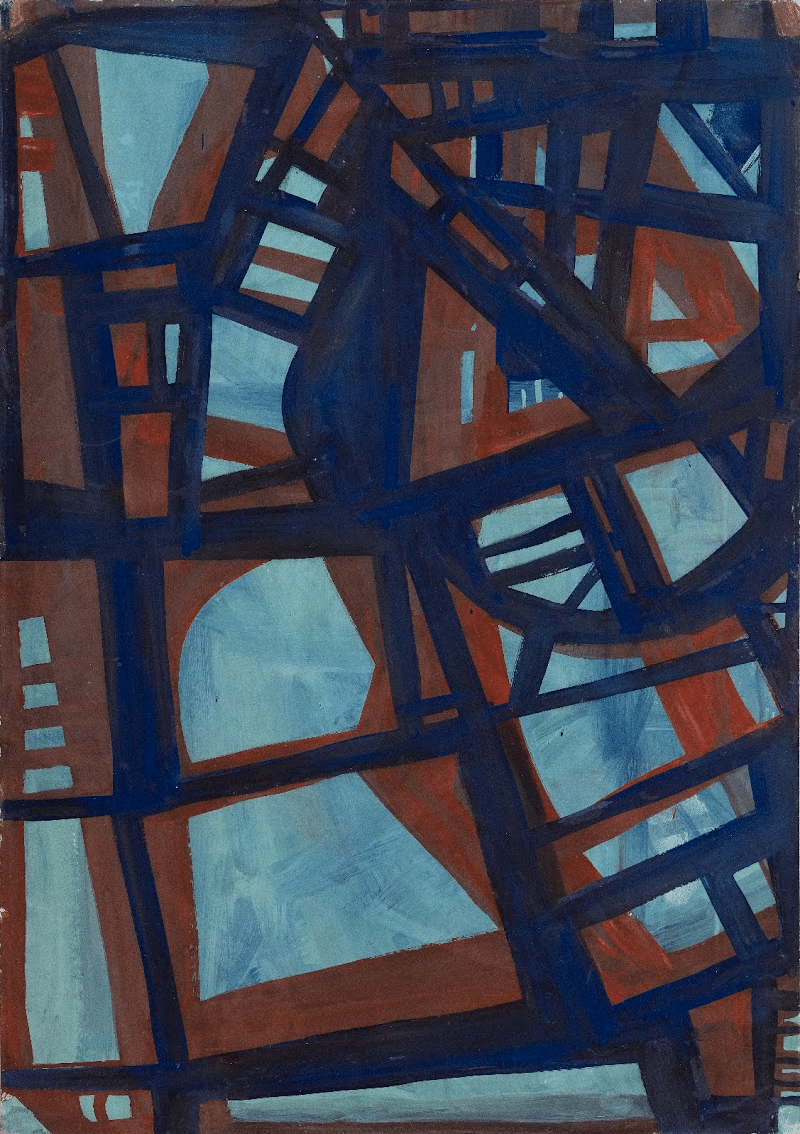
Avto Meskhi. Abstraction. Gouache on paper. 59x42cm. 1987. ATINATI Private Collection
Viewing Avto Meskhi's work within the frames of Western or local trends is particularly interesting, because it reveals his self-sufficient and atypical artistic identity. In the 1970s-80s, a number of artists emerged on the Tbilisi art scene, among them Albert Dilbariani, Vati Davitashvili, Temo Japaridze, Otar Chkhartishvili, Sergo Parajanov, Amir Kakabadze, and Vakhtang Kokiashvili, which became closely associated with the stigma of unofficially sanctioned or nonconformist art. These representatives of the Soviet “underground” created works across a wide range of themes—multimedia, abstract, and formalist paintings, erotically charged compositions, collages, and Socialist Art (SocArt). The identity of unofficial art was thus inherently mosaic: it was not defined by a single style, medium, or ideology, yet its common goal was the symbolic dismantling of the Soviet system through the integration of Western artistic elements. Against this background, Meskhi seemed to be more attuned to internal, immanent traumas than to explicitly social or political concerns. His expressive world is neither marked by pain nor by the optimistic tone of Socialist Realism; rather, it forms an abstract micromodel, born of artistic leisure and a kind of aesthetic hedonism. Likewise, it is difficult to draw clear parallels between Meskhi and Western avant-garde artists—be they Piet Mondrian, Paul Klee, Joan Miró, Kazimir Malevich, Wassily Kandinsky, or El Lissitzky. Avto Meskhi’s Caucasian chromatic tragedy, sense of form, patterning, and schematic composition stand in stark dissonance with the aesthetic norms of European modernism, such as that of De Stijl, Suprematism, Bauhaus, and Orphism. His muted, subdued color spots, the forms modulated through tone rather than line, and the profound spatial layers evoke something far more archaic and archetypal than European.
The light in Meskhi’s paintings is reminiscent of Pirosmani’s—it is not naturalistic, but mystical; more spiritually transcendent than materially tangible. Within Meskhi’s artistic world, the human being seems either fully surrendered to a higher force, or helpless before the unknowable essence of existence. This notion is further supported by the semantic detonations present in the titles of his works—poetic, and often irrational. Titles such as King of the Dead, Personally Known, Green Nose, The Read Book, and Uninvited Guests gesture towards a world where mythology and Zaum coexist. When taken in conjunction with the imagery, these titles create a sense of Dadaist absurdity. It becomes difficult to align the scenes he depicts with either utopian or dystopian models.
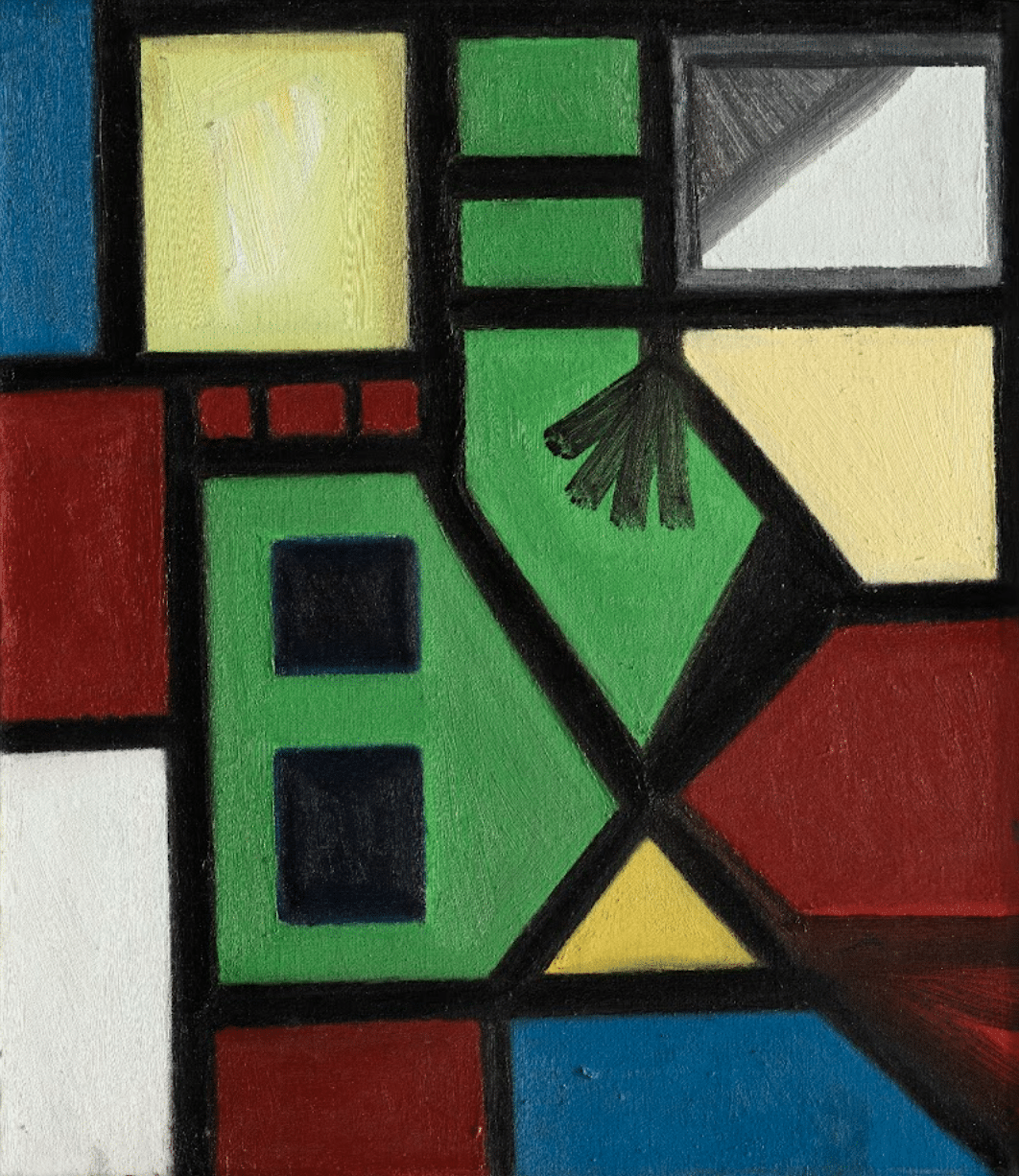
Avto Meskhi. Yellow Lampshade. Oil, canvas. 40x35cm. 2010. ATINATI Private Collection
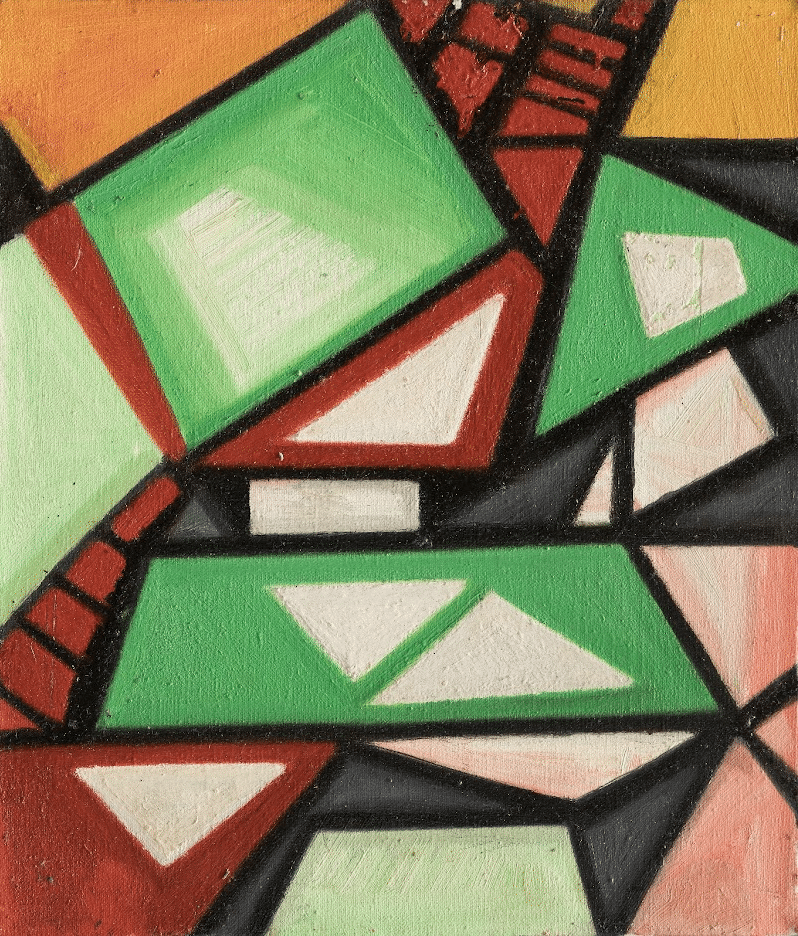
Avto Meskhi. Reflection. Oil, canvas. 30x35cm. 2011
Avto Meskhi’s most significant artistic pieces were created between the 1980s and his death. His work can be divided into several distinct cycles: collages (1990s), an abstract pencil series (1990s), compositions in felt-tip pen that blend the figurative and non-figurative (2000s), and a series of abstract works on canvas or paper in gouache (1980s).
His 1980s works—executed in gouache on paper or oil on canvas—reflect a period of geometric abstraction in Meskhi’s practice. These pieces bring together elements such as the fusion of top and side views, tonal-chromatic gradations, idiosyncratic patterning, polycentric composition, sharp or subdued coloration, and the integration of figurative imagery within geometrized lattice structures.
His 1990s collages are both political and deeply personal. On multifigural or subtly layered planes, everyday objects emblematic of the era erupt into localized visual detonations. Within these compositions—dense with the heavy columns of Soviet newspapers and the faces of political tabloids—it is as if the individual, or the artist himself, vanished. The viewer is met with a landscape of utilitarian fragments, instantly recognizable, yet charged with ambiguity: for the post-Soviet individual, these items might represent either delight or dread—or both at once.
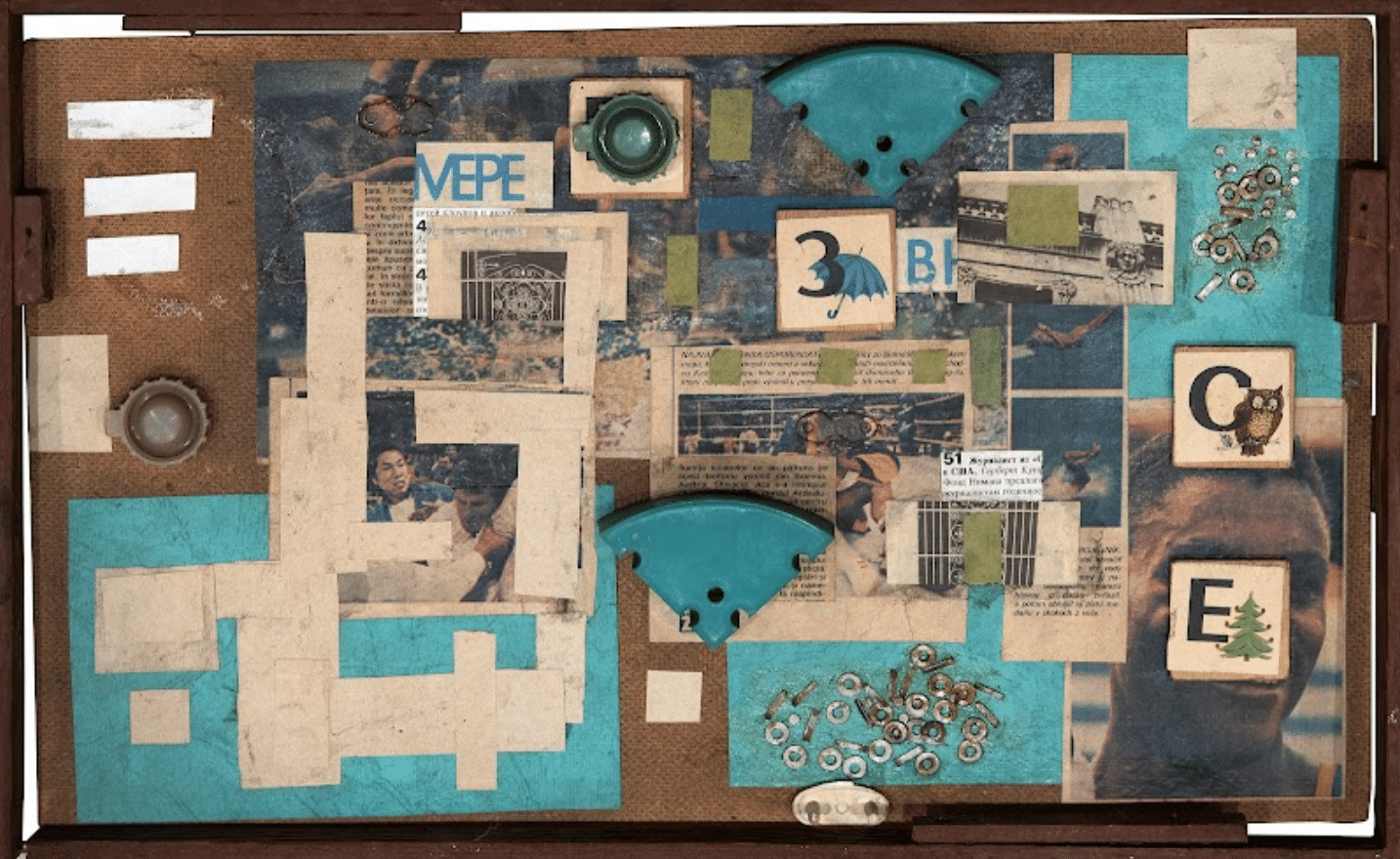
Avto Meskhi. Lord of the Dead. Pop art. 28,5x45,5cm. 1991. ATINATI Private Collection
Avto Meskhi’s abstract pencil series recalls the kinetic delicacy of Alexander Calder’s mobiles, as well as the compositional logic of Soviet mosaic panels. Through their dynamic rhythms, localized color spots, weightlessness, and asymmetry, these drawings evoke a tension between material presence and ethereal detachment, while, in his felt-tip pen series, the figurative and non-figurative, the emerging colors, the scenes of everyday life, and the titles of the works merge. Meskhi’s artistic world—fragmented into grids or net-like prisms—remains deliberately impenetrable. His mise-en-scènes are sterile in their communicative intent, and remain kaleidoscopically elusive.
P.S.
In an interview, Avto Meskhi remarked: “Everything in life has a real foundation, and a person perishes in all of it. But through art, one escapes the reality.” True to his belief, his abstract works strive to liberate the human spirit from the confines of reality. Meskhi’s transcendental world belongs to all who wish to rise above everyday existence, routine, and banality—through art.
The artist seemed to live within a vast mythological storyline. Like a modern-day Minotaur, Meskhi wandered the abstract labyrinths of his imagination, deliberately choosing to stay there—perhaps in response to the suffocating conditions of Soviet life. His compositions, be they figurative or non-figurative, are frequently slashed with lattice and grid painting. These structures may have served as a form of self-imposed isolation. Confined physically but boundless in vision, Meskhi remained at home, enveloped by a cast of spectral figures—like a duende communing with his creations. His artistic universe oscillated between utopia and dystopia, reflecting the inner contradictions of a soul both haunted and liberated by its own myths.